
Opening a restaurant in New York City means clearing four agencies, not one. The core restaurant permits NYC requires are a Department of Buildings (DOB) alteration permit for the buildout, a Food Service Establishment Permit from the Health Department (DOHMH), FDNY fire and cooking approvals, and, if you serve alcohol, a State Liquor Authority (SLA) license.
Add a Certificate of Occupancy and Food Protection Certificate, and you have the short list every NYC operator has to satisfy before the doors open. Below is the full breakdown by agency, with typical costs, timelines, and the order to file them.
Key Takeaways
- Four agencies regulate a NYC restaurant: DOB (construction and occupancy), DOHMH (food safety), FDNY (fire and cooking), and the NYS SLA (alcohol).
- The Food Service Establishment Permit is about $280 (plus $25 if you make frozen desserts), and you can open 22 days after applying, even before your first Health inspection.
- A change of use to “eating and drinking” usually needs a new or amended Certificate of Occupancy, filed through a DOB alteration.
- Any space seating 75 or more people indoors needs a Place of Assembly Certificate of Operation from DOB.
- A full on-premises liquor license in NYC commonly takes 6 to 10 months; a Temporary Retail Permit (about $253, roughly 30 days to process) lets you serve while you wait.
- Permits and fees are set by the agencies and change often. Treat every figure here as a typical range, not a guarantee. This is not legal advice.
What Restaurant Permits Does NYC Require to Open?
A NYC restaurant needs permits and approvals from four separate agencies, plus a handful of licenses tied to your entity and your menu. No single “restaurant permit” covers all of it.
You file the buildout work with DOB, the food operation with the Health Department, the fire and cooking systems with FDNY, and, if alcohol is on the menu, the license with the State Liquor Authority.
Here is the working list most sit-down restaurants need. Quick-service, delivery-only, and bar concepts vary, so confirm your scope with your architect and expeditor early.
| Permit or approval | Agency | Typical cost | Typical timing |
| Business entity, EIN, Certificate of Authority (sales tax) | NYS Dept. of State, IRS, NYS Tax & Finance | Filing fees vary | Certificate of Authority can take weeks |
| Alteration permit (Alt-1 or Alt-2) | NYC DOB | Scope-based | Plan review roughly 2 to 8 weeks |
| Certificate of Occupancy or Letter of No Objection | NYC DOB | Included in filing | Depends on change of use |
| Plumbing, mechanical, electrical, sprinkler, fire alarm | NYC DOB (licensed trades) | Trade-based | Runs with construction |
| Fire suppression and cooking approvals | FDNY | System-based | Coordinated with buildout |
| Place of Assembly (75+ indoors) | NYC DOB, then FDNY | Filing fees | Added to the alteration |
| Food Service Establishment Permit | NYC DOHMH | ~$280 (+$25 frozen desserts) | Open 22 days after applying |
| Food Protection Certificate | NYC DOHMH | Course + exam fee | Before opening |
| On-premises liquor license (if serving alcohol) | NYS SLA | ~$4,352 NYC full on-premises | ~6 to 10 months |
| Sidewalk or roadway dining (if outdoor seats) | NYC DOT (Dining Out NYC) | Program fees | Seasonal program |
Building without the required DOB permits can trigger a Stop Work Order and civil penalties, so the permit work comes first, before demolition. A seasoned contractor sequences these filings so trades are not waiting on paperwork. That coordination is the core of our restaurant and retail buildout services.
Who Issues Restaurant Permits in NYC, and What Does Each Cover?
Four agencies own different parts of your restaurant, and each has its own review and inspection. Knowing who controls what tells you where a delay will come from and who your architect and expeditor need to satisfy.
- NYC Department of Buildings (DOB): construction, egress, occupancy, and the Certificate of Occupancy. Your alteration permit, trade permits, and Place of Assembly all live here.
- NYC Department of Health and Mental Hygiene (DOHMH): food safety. The Food Service Establishment Permit and Food Protection Certificate come from DOHMH, and it inspects and grades you after you open.
- Fire Department (FDNY): fire protection and commercial cooking. Hood suppression, sprinkler and alarm sign-offs, and the Place of Assembly permit sit with FDNY.
- New York State Liquor Authority (SLA): alcohol. This is a state agency, separate from the City, with its own months-long timeline.
For a fuller picture of how these approvals fold into a construction schedule, see our NYC commercial buildout process, step by step.
How Much Do NYC Restaurant Permits Cost?
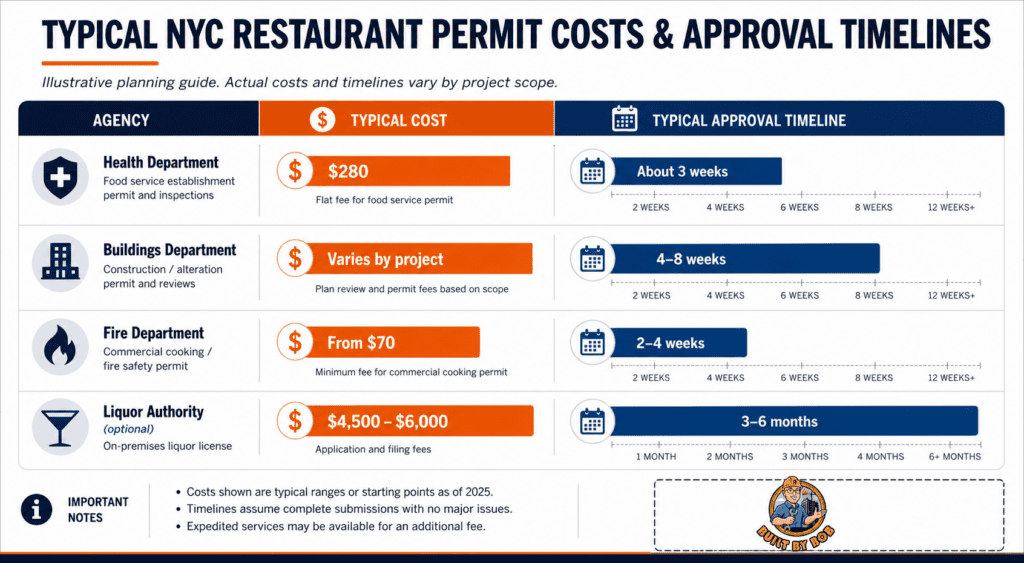
Permit fees are a small line item next to construction, but they are real and they stack. The Food Service Establishment Permit is about $280, plus $25 if you make frozen desserts.
DOB alteration and trade permit fees are scope-based and scale with the size and complexity of the job. A full on-premises liquor license in New York City runs about $4,352 in state fees, and the all-in first-year cost, once you add professional help and background checks, is usually much higher.
Two points keep budgets honest. First, permit fees are separate from the professional fees for the architect, engineer, and expeditor who prepare and file the work.
Second, permits expire and renewals cost money, so a buildout that drags on can add fees you did not plan for. Present these as typical ranges to your investors, because the city sets them and they change.
Do I Need a New Certificate of Occupancy for My Restaurant?
Often, yes. If you are converting a space that was not previously an eating-and-drinking establishment, for example a former boutique or office, you usually need a new or amended Certificate of Occupancy that reflects the restaurant use. That is filed as an Alteration Type 1 (Alt-1) with DOB, which changes use, egress, or occupancy and ends with a new CO.
If the space was recently a restaurant and you are not changing the use, egress, or occupancy, your work may qualify as an Alteration Type 2 (Alt-2), which does not change the CO and can move faster. In some cases a Letter of No Objection (LNO) confirms the existing use is acceptable, which avoids a full CO amendment.
You cannot legally open until a final CO or a Temporary Certificate of Occupancy covers the space, so settle this during design, not at the finish line. A prior restaurant use is a real advantage, because grease traps, venting, and gas hookups may already be in place.
That is one reason lease selection matters as much as the buildout itself. Our completed NYC buildouts show both conversions and restaurant-to-restaurant refits.
What Permits Do the Kitchen and Fire Systems Need?
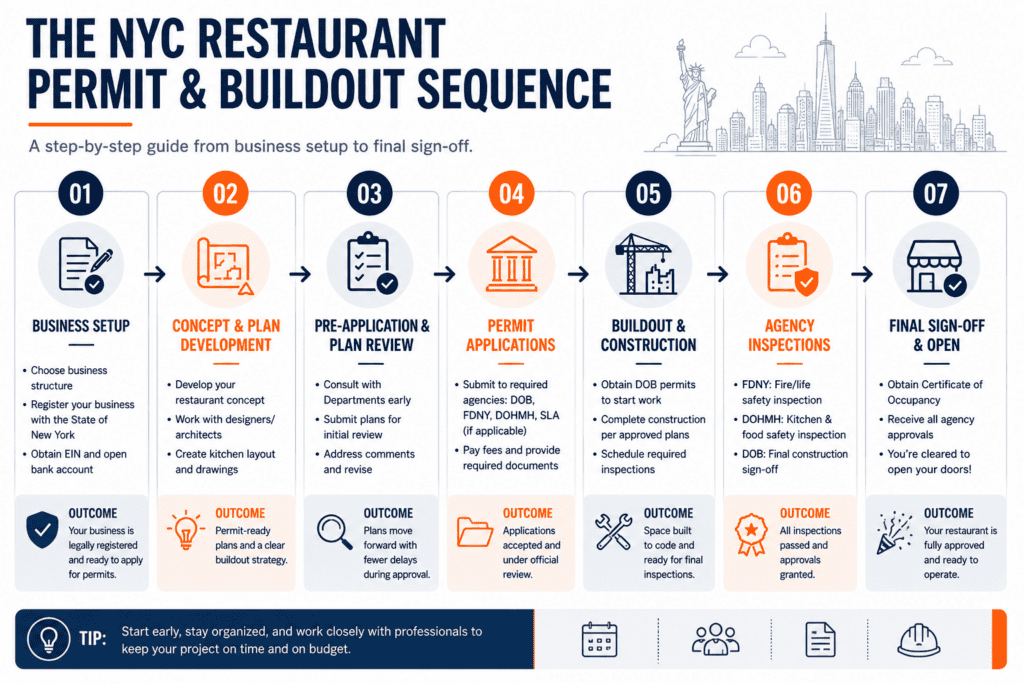
Any restaurant with a cooking line that produces grease-laden vapors needs a Type I exhaust hood with an automatic fire-extinguishing system, ducted to the exterior and built to NFPA 96 and UL 300 standards.
These systems are reviewed by both DOB and FDNY, and the hood suppression system needs periodic service by a licensed company once you are open. Installing a hood without the mechanical permit is a common and expensive mistake.
Occupancy triggers another approval. A space where 75 or more members of the public gather indoors (or 200 or more outdoors) needs a Place of Assembly Certificate of Operation from DOB, and within a year the establishment must also hold a Place of Assembly permit from FDNY.
If your dining room crosses that seat count, build the Place of Assembly filing into your plans from the start, because it affects egress, exit signage, and your final sign-offs.
How Long Does It Take to Get a Liquor License in NYC?
Plan on 6 to 10 months for a full on-premises liquor license in New York City. The SLA’s standard processing runs roughly 22 to 26 weeks, and in Manhattan, Brooklyn, and Queens the 500-foot rule hearing (triggered when three or more licensed premises already sit within 500 feet) can add several more months.
The SLA also enforces a 200-foot rule that blocks licenses within 200 feet of a school or house of worship, and restaurants must have a full kitchen to qualify.
Because few operators can pay rent for six-plus months with no bar revenue, most use a Temporary Retail Permit (TRP). It costs about $253, is processed in roughly 30 days, and is valid for 180 days, letting you serve alcohol while the full license is reviewed.
Start the SLA application as early as possible, ideally while construction is underway, since it is the single longest item on the whole permit list. If you plan outdoor seating with alcohol, note that the City’s Dining Out NYC program (run by DOT) and a separate SLA approval both apply before you can serve a drink at a sidewalk or roadway table.
The NYC Restaurant Permit Process, Step by Step
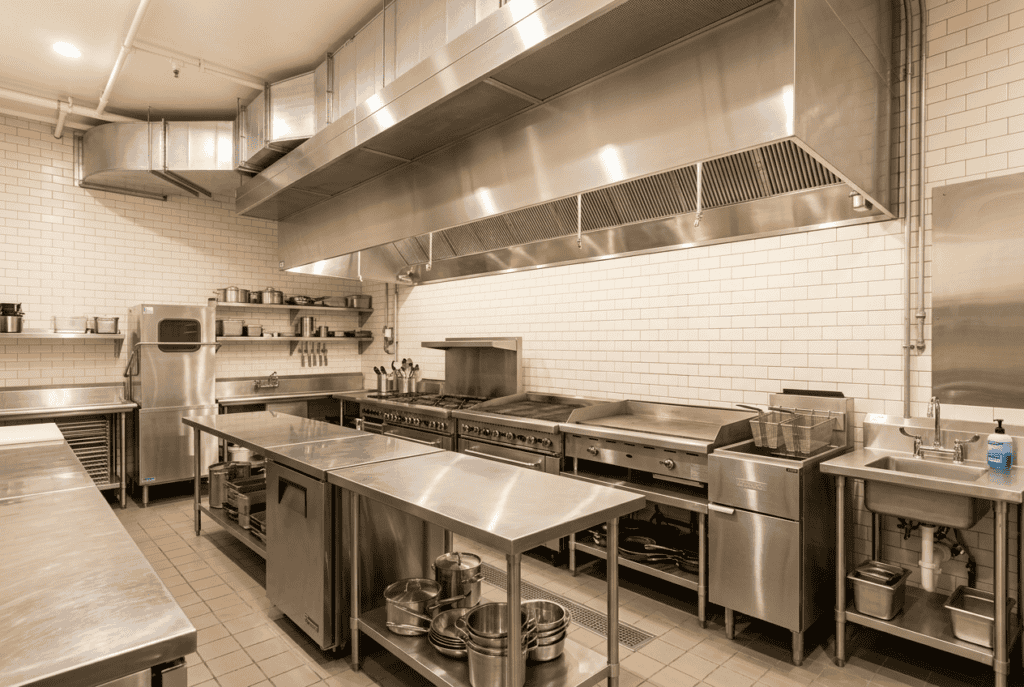
Here is the order that keeps a project moving. Every borough follows the same sequence, though co-op, condo, and landmark buildings add landlord and agency reviews on top.
- Set up the business and confirm the space. Form your entity, get an EIN, and apply for a Certificate of Authority to collect sales tax. Confirm the Certificate of Occupancy or LNO allows an eating-and-drinking use before you sign the lease.
- Hire a registered architect or engineer and file the DOB alteration. Your design professional files the Alt-1 or Alt-2, and a plan examiner reviews for zoning and code objections.
- Pull the trade permits and build. Licensed plumbers, mechanical, electrical, and sprinkler contractors file their permits and the buildout begins.
- Handle fire protection and Place of Assembly. Install the Type I hood and suppression to code, and file the Place of Assembly work if you seat 75 or more.
- Apply for the Food Service Establishment Permit and Food Protection Certificate. File with DOHMH; a supervisor with a Food Protection Certificate must be on site during all hours.
- File the liquor license early, if you serve alcohol. Submit to the SLA and use a Temporary Retail Permit to open on schedule.
- Pass final inspections and get your sign-offs. Close out DOB and FDNY inspections, obtain the CO or Temporary CO, confirm the Health permit is issued, and open. DOHMH will visit unannounced after opening to grade you.
For how these steps map to a realistic calendar, see our guide on how long a NYC restaurant buildout takes.
Restaurant Permit Questions NYC Owners Ask
Do I need a permit to open a restaurant in NYC? Yes. At a minimum you need a DOB alteration permit for the buildout, a Food Service Establishment Permit from the Health Department, FDNY fire and cooking approvals, and a Certificate of Occupancy that allows an eating-and-drinking use. Serving alcohol adds a State Liquor Authority license.
Which NYC agency issues restaurant permits? Several. DOB handles construction and occupancy, DOHMH handles the food operation, FDNY handles fire and cooking systems, and the New York State Liquor Authority handles alcohol. The City agencies and the state agency all review separately.
How much is a NYC Food Service Establishment Permit? It is about $280, with an extra $25 if you make frozen desserts. That fee is separate from your DOB, FDNY, and liquor filings, and from the professional fees to prepare them.
Can I open before my Health Department inspection? In most cases you can open 22 days after you submit your Food Service Establishment Permit application, even if the pre-permit inspection has not happened. If you want to open sooner, you can request a pre-operating inspection.
Do I need a new Certificate of Occupancy for a restaurant? Usually, if you are changing the space to an eating-and-drinking use. That is filed as an Alteration Type 1 and ends with a new CO. If the use is not changing, an Alteration Type 2 or a Letter of No Objection may be enough.
How long does a NYC liquor license take? A full on-premises license commonly takes 6 to 10 months in New York City. A Temporary Retail Permit, processed in about 30 days and valid for 180 days, lets you serve while the full license is reviewed.
Do I need a permit for sidewalk or outdoor seating? Yes. Sidewalk and roadway dining run through the City’s Dining Out NYC program, and if you want to serve alcohol outdoors you also need separate State Liquor Authority approval for that area.
Talk to a NYC Restaurant Builder Before You File
The fastest way to lose weeks is to file in the wrong order or discover a Certificate of Occupancy problem after demolition. Built by Bob builds retail, franchise, and restaurant spaces across all five boroughs and manages the full DOB, DOHMH, and FDNY process under one dedicated point of contact, so you are not chasing agencies while trying to open.
If you are scoping a new location or a conversion, request a quote or consultation and we will map the permit path for your specific space. For franchise operators opening multiple units, our complete NYC restaurant buildout guide is a good next read.