
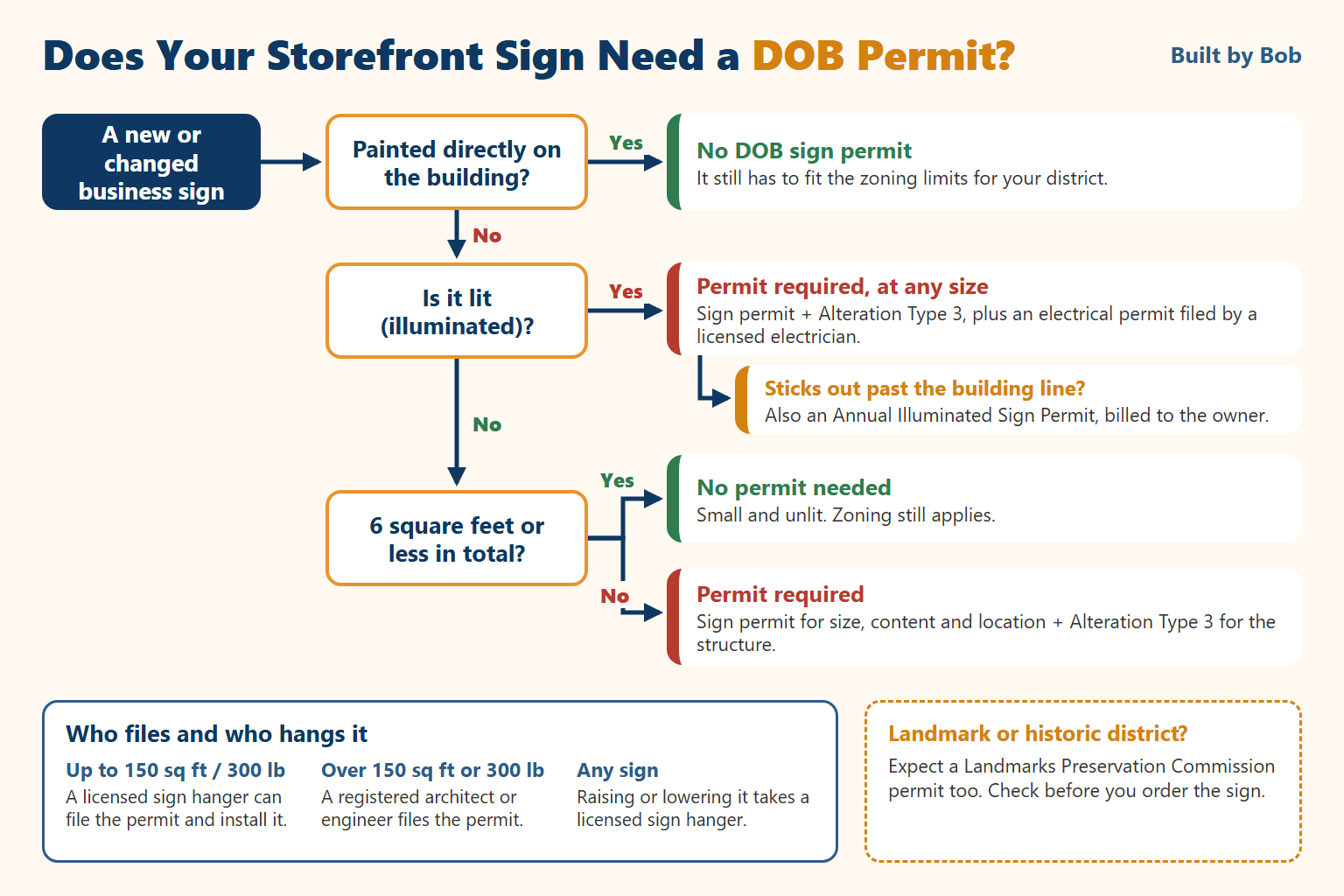
In New York City, most storefront signs need a Department of Buildings (DOB) sign permit. The only exceptions are signs painted directly on the building and unlit signs of six square feet or less. Every illuminated sign needs a permit at any size, and every sign, permitted or not, has to fit the zoning limits for your district. A licensed sign hanger must install it.
Our guide to franchise construction permits in NYC lists the sign as one of several filings. This post goes one level deeper: which permits a sign actually needs, who is allowed to file and hang it, how big it can be in your zoning district, how far it can stick out over the sidewalk, and what changes on a landmark block.
Key takeaways
- Six square feet and no lights is the only size exemption. Anything larger, or anything lit, needs a DOB permit.
- One sign can mean up to four filings: a sign permit, an Alteration Type 3 permit, an electrical permit and, for lit signs past the building line, an annual illuminated sign permit.
- 150 square feet and 300 pounds is the line between a sign hanger filing and an architect or engineer filing.
- Your zoning district sets the size. In a C2 district, total sign area is three times your street frontage, capped at 150 square feet.
- Landmark and historic district buildings need a second approval from the Landmarks Preservation Commission (LPC).
Does my storefront sign need a DOB permit?
Probably yes. DOB only skips the permit for a sign painted directly onto the building or a sign that is smaller than six square feet in total area and not illuminated. A lit sign needs a permit no matter how small it is.
Three questions settle it: Is it painted on the wall? Is it lit? Is it more than six square feet? Measure the whole sign, not only the letters, and remember that “no permit” never means “no rules”. DOB’s step-by-step guide says a sign without a permit must still comply with zoning.
The rules on this page are for business signs, which zoning calls accessory signs: signs for the business on the same property, like your name over the door. A sign that advertises something sold somewhere else is an advertising sign, which zoning restricts far more tightly.
Which permits can one sign need?
Up to four. A plain sign over six square feet needs two, a lit sign needs three, and a lit sign that sticks out past the building line needs a fourth that renews every year. All sign permit requests are filed online in DOB NOW: Build.
| Permit | What it covers | When you need it |
|---|---|---|
| Sign permit | Size, wording and location of the sign | Any sign that is not painted on and is over 6 sq ft, and every lit sign |
| Alteration Type 3 | The structure and how the sign is attached | With the sign permit |
| Electrical permit | The wiring and connection, filed by a licensed electrician | Any sign with an electrical connection |
| Annual illuminated sign permit | A yearly permit and fee | A lit sign that extends beyond the building line |
The annual permit is easy to miss when you are a tenant. DOB says the renewal bill comes from the Department of Finance and goes to the property owner, not the tenant, so agree with your landlord in writing who pays it.
Who is allowed to file the permit and hang the sign?
It depends on size and weight. A licensed sign hanger can file and install a sign of up to 150 square feet and up to 300 pounds. Above either number, a registered architect or professional engineer must be the applicant. Raising or lowering any sign takes a licensed sign hanger.
- Master Sign Hanger: licensed for signs of any size or weight.
- Special Sign Hanger: licensed for signs up to 150 square feet in total area and 1,200 pounds.
- Registered general contractor: may install non-illuminated business signs with a limited amount of text.
DOB keeps a public list of licensed sign hangers. Ask for the license number before you pay a deposit, and make sure the sign shop’s quote says who files the permit.
How big can my sign be?
Your zoning district decides. Look up the address on the city’s ZoLa zoning map, then read the matching row below. Most limits are a multiple of your street frontage with a cap, plus a maximum height above the curb.
| District | Largest single sign | Total sign area | Highest point |
|---|---|---|---|
| C1, C2 | 150 sq ft | 3 × frontage, up to 150 sq ft (lit signs: up to 50 sq ft) | 25 ft |
| C3 | 50 sq ft | 50 sq ft | 25 ft |
| C5 (except C5-4) | 200 sq ft | 3 × frontage, up to 200 sq ft | 25 ft |
| C4, C5-4, C6 (except C6-5, C6-7) | 500 sq ft | 5 × frontage, up to 500 sq ft | 40 ft |
| C6-5, C6-7, C7 | No zoning size limit for accessory signs | ||
Example: a café with 25 feet of frontage in a C2 district gets 3 × 25 = 75 square feet of total sign area. If its signs are lit, the lit total is capped at 50 square feet. The same 25 feet in a C4 district allows 5 × 25 = 125 square feet.
Some districts limit or ban illuminated and flashing signs, and DOB’s chart notes that up to three illuminated, non-flashing window signs totaling 8 square feet or less are exempt from these limits. If your store sits in a special district or on a residential block, check before you design.
How far can a sign stick out over the sidewalk?
Not far. In commercial districts, Zoning Resolution 32-652 lets a business sign project across the street line no more than 12 inches, or 18 inches for a double-faced or multi-faced sign.
Awnings have their own rule. Under Zoning Resolution 32-653, a sign on an awning or canopy must be non-illuminated, no larger than 12 square feet, with letters no taller than 12 inches, and it may only identify the building or a business in it. A sign on a marquee, outside C6-5 and C6-7 districts, may rise no more than 48 inches above the marquee and hang no more than 12 inches below it.
Remember the fourth permit: once a lit sign extends beyond the building line, it also needs the annual illuminated sign permit.

What changes if my building is a landmark or in a historic district?
You usually need a Landmarks Preservation Commission permit as well as the DOB permit. LPC staff can approve a sign quickly when it meets the commission’s published criteria. Otherwise, the design can go to a public hearing.
From the LPC permit guidebook on signage, the criteria a sign shop should design to:
- Individual dimensional letters no taller than 18 inches, projecting no more than two inches from the signband or panel.
- A flat sign panel in the signband no larger than 90 percent of the signband’s area.
- Vinyl or painted signage on the glass covering no more than 20 percent of each glazed area.
- Bracket and banner signs close to the business they name, with the armature below the second story or at the lowest point zoning allows.
- Colors that suit the building. The guidebook says no neon or other vividly bright colors in the signband.
Some work needs no LPC permit, such as interior signs more than 18 inches behind the display window, sandwich boards, and temporary signs that do not attach to the building. The LPC application asks for the DOB filing drawings when the work also needs a DOB permit, so prepare both together. Not sure? LPC answers at 212-669-7817.
Where does the sign fit in the buildout timeline?
Alongside it, not at the end. The sign is a separate permit track from your interior alteration permits, so it can be designed and filed while construction runs. Leave it to the end and the sign can still be in review when the space is ready to open.
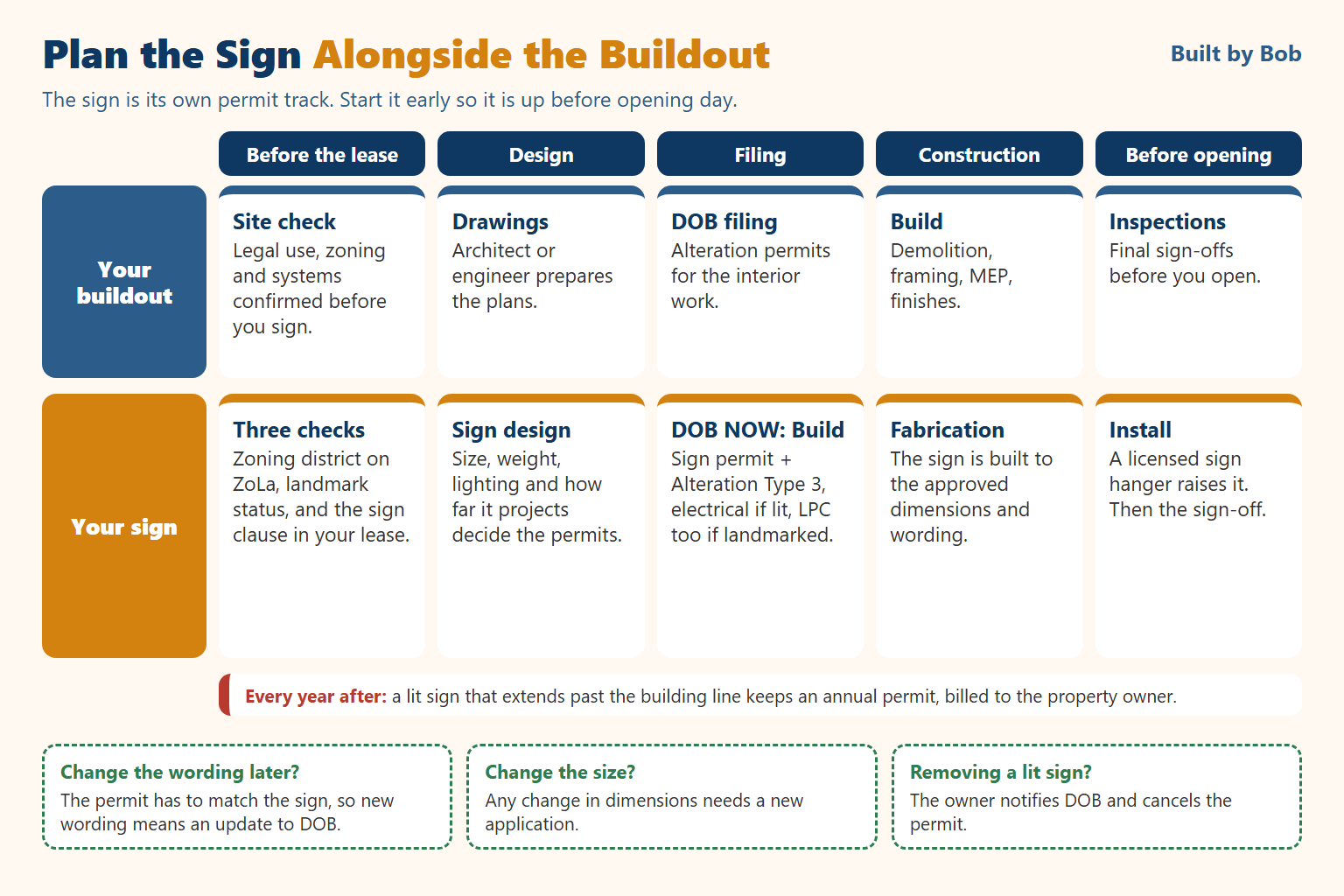
Do three checks before you sign the lease, the same way you would check the CO and the duct route in our pre-lease site check: the zoning district on ZoLa, whether the building is a landmark or in a historic district, and what the lease says about signs on the facade. Then lock the sign’s size, weight, lighting and projection before filing. Those four facts decide which permits you need and who files them. For the interior side, see our commercial buildout process and the full list of restaurant permits.
What happens if I put up a sign without a permit?
DOB can issue violations and civil penalties. Its business sign guide says signs that do not comply with the construction codes, the Zoning Resolution and the city’s rules could result in both.
You may have heard about a “sign amnesty”. The city has paused some storefront sign violations under a temporary sign program and later extensions, but those pauses covered signs that already existed on a set date. They do not cover a new sign you put up for a new business, so file before you install, and check DOB’s sign page for the current status of any program.
FAQ
Can my general contractor hang the sign?
Only in a narrow case. DOB lets a registered general contractor install a non-illuminated business sign with a limited amount of text. Other signs need a licensed Master or Special Sign Hanger.
Who pays the yearly illuminated sign fee?
The bill goes to the property owner. The Department of Finance sends it to the owner, not the tenant, so settle in the lease who reimburses whom.
I am only changing the wording on my sign. Do I need a new permit?
The permit must match the current wording. DOB says the owner sends a signed letter with the new wording, the location, the permit number and the dimensions. Changing the size needs a new application.
Where do I file a sign permit?
Online in DOB NOW: Build. The applicant is the licensed sign hanger for signs up to 150 square feet and 300 pounds, or a registered architect or engineer for anything larger.
How far can my sign project over the sidewalk?
In commercial districts, up to 12 inches across the street line, or 18 inches for a double-faced sign, under Zoning Resolution 32-652. Signs on awnings must be unlit and no larger than 12 square feet.
Plan your storefront with Built by Bob
Built by Bob’s retail construction work covers storefront construction, exterior signage and branding, and awnings, canopies and lighting. Bring us your address and the sign design early. We handle the DOB filings for your buildout, sign included: we bring in the licensed sign hanger and schedule the electrical work alongside the rest of the build, so the sign goes up before opening day.
Book a free on-site consultation, or call 347-201-5018, or 718-200-8008 for our Chinese-language line.
This article explains general permitting rules. It is not legal advice. Codes, zoning and agency requirements change and depend on the building. Confirm current requirements with DOB, the Department of City Planning and LPC for your address.